
For the knot will not budge. Focused, sustained pressure on the specific spots creating your tension, held exactly as long as it takes for them to let go.
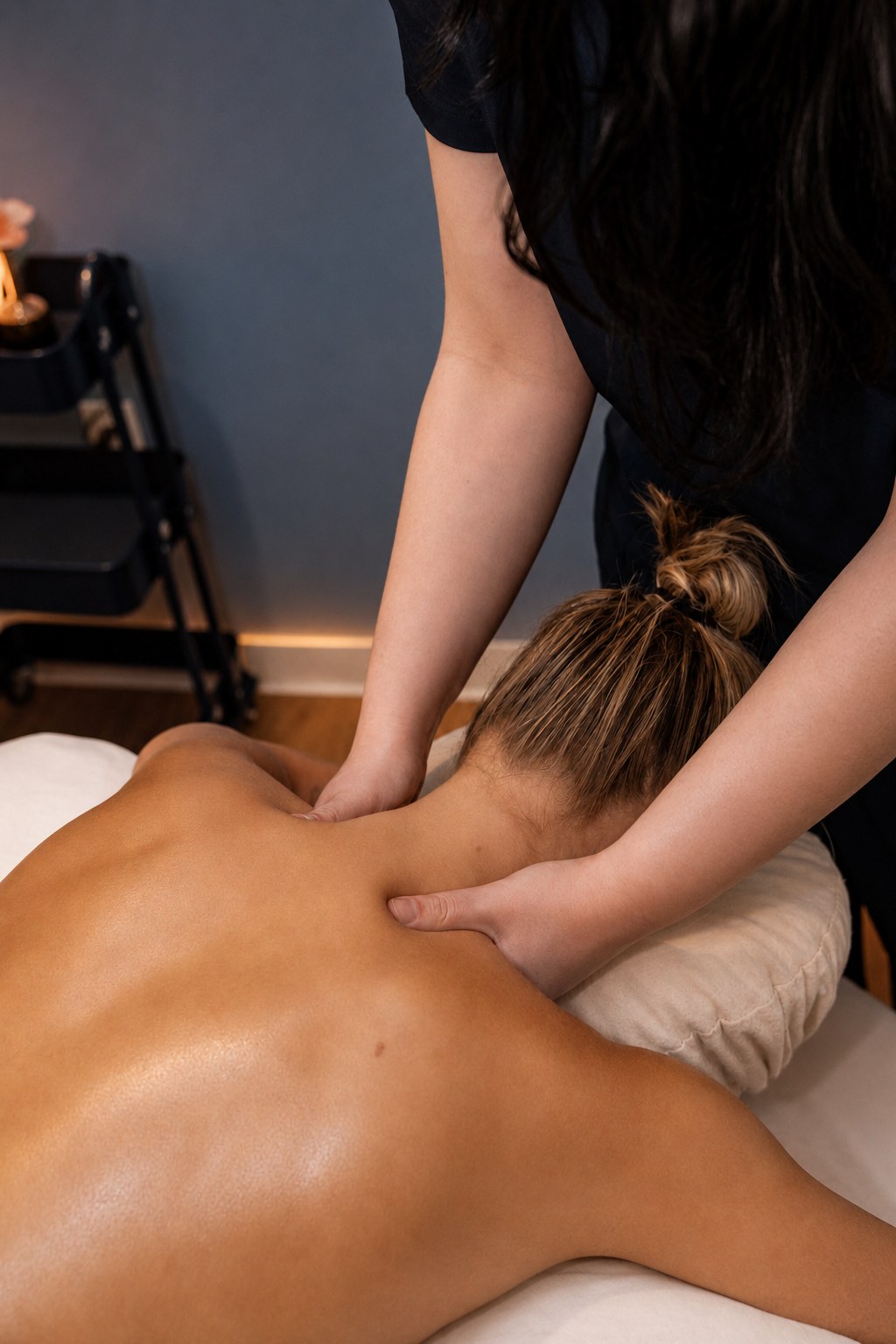

Almost everyone has one. The knot between the shoulder blade and the spine that you have been digging at with a tennis ball for two years. The tight band in the side of the neck that turns into a headache by Thursday. The spot in the hip that makes you shift in your chair a hundred times a day. Trigger point therapy at Life Massage and Wellness in Portsmouth, NH is built specifically for those.
A trigger point is a small, hyperirritable knot within a taut band of muscle. Press it and it is exquisitely tender. More importantly, press it and it often reproduces the exact discomfort you have been living with, sometimes in a place several inches away. That reproduction is the whole diagnostic value of this work, and it is the moment clients most often say some version of that is it, that is the thing.
The treatment is straightforward and remarkably effective. Your therapist locates the point, applies steady sustained pressure, and holds while the knot softens and the referred sensation fades. Then the muscle is lengthened so it holds its new state. It is not a full-body massage; it is precise, targeted work aimed at a small number of specific structures, which is exactly why it can change something that months of general massage did not.
Sessions run 60 or 90 minutes at our Portsmouth studio, and you leave knowing exactly what your therapist found and how to keep it from coming back.
Five reasons people in Portsmouth book trigger point therapy for tension that has outlasted everything else.
Work aimed at specific knots rather than spread acrross the whole body.
Addresses the point creating symptom, not just where you feel it.
Range of motion often opens noticeably within single session.
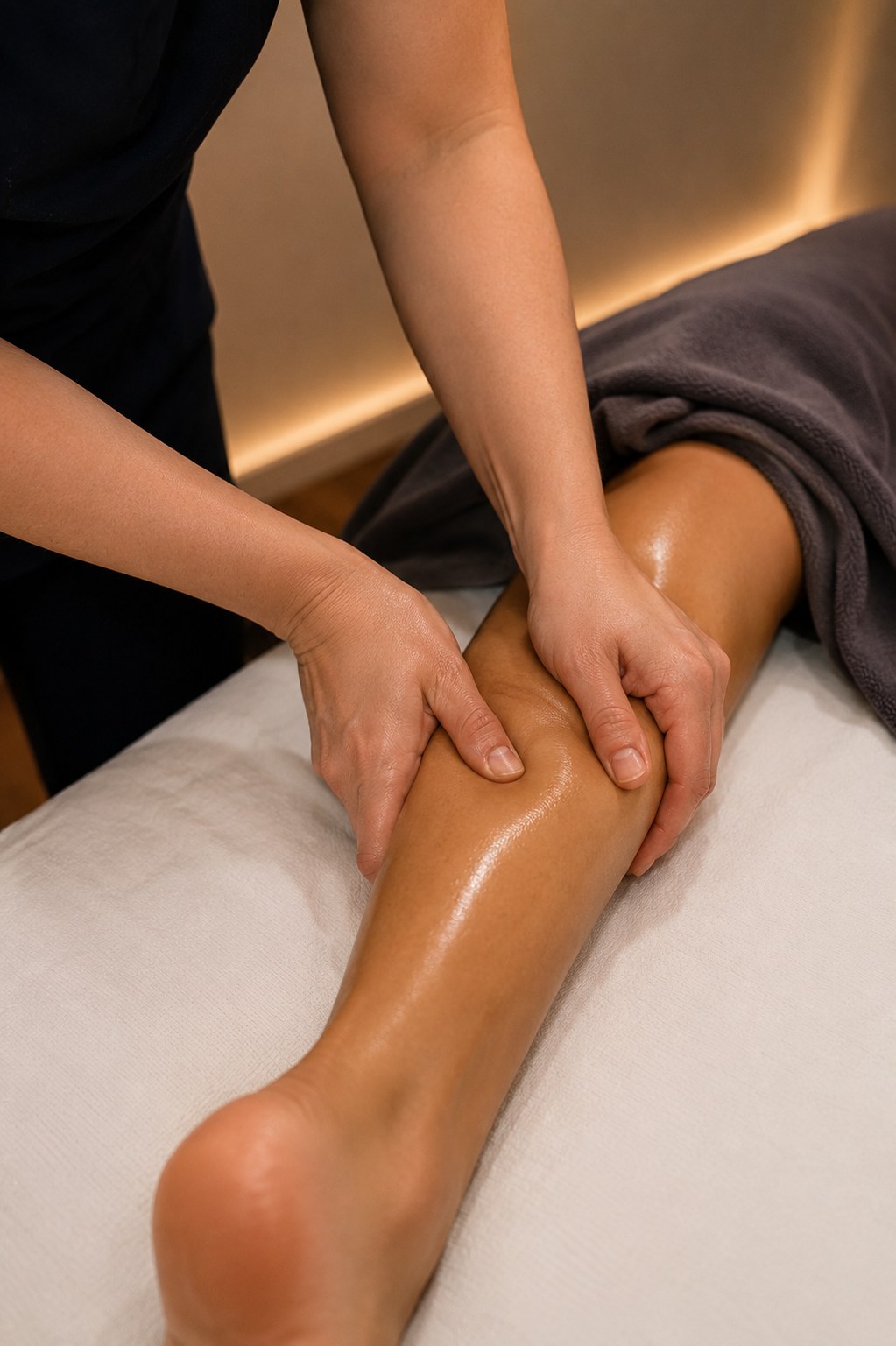
Trigger point therapy is a focused manual technique for locating and releasing myofascial trigger points, the small hyperirritable nodules that form within taut bands of muscle fiber. Under the finger they feel like a hard pea or a tight cord that is noticeably firmer than the tissue around it, and they are exquisitely tender in a way the surrounding muscle is not.
Trigger points form for ordinary reasons. Muscle held in a shortened position for hours, such as the upper back of anyone who works at a screen. Repetitive motion, whether that is a golf swing or a mouse click. Sustained low-grade stress, which keeps muscle partially contracted around the clock. Old injuries that changed how you move. Once formed, a point tends to stay, because the shortened fibers restrict their own blood supply and create a small self-sustaining loop.
The defining feature is referral. A trigger point in the upper trapezius commonly refers sensation up the side of the neck and into the temple. One in the gluteal muscles can send discomfort down the back of the thigh. One in the jaw muscles can produce what feels convincingly like toothache. These patterns are consistent from person to person and have been mapped in detail, which is what allows a trained therapist to work backward from your symptom to the muscle likely responsible.
That backward reasoning is why trigger point therapy so often succeeds where rubbing the sore spot failed. If your headache originates from a point in your shoulder, no amount of attention to your temples will resolve it.
Once located, the release itself is unhurried. Your therapist applies steady, direct pressure to the point and simply maintains it. Under sustained compression, the local blood supply is briefly restricted and then floods back when pressure lifts, the contracted fibers begin to release, and the nervous system gradually stops treating the area as an emergency. The whole process usually takes between thirty and ninety seconds per point, and the tenderness noticeably decreases while the pressure is still being held.
That decrease is the signal both of you are waiting for. Your therapist will ask you to rate the sensation on a scale of one to ten, and the target is around a seven: unmistakably strong, clearly productive, and never so intense that you hold your breath or tense up elsewhere. When the number drops to a three or four under unchanged pressure, the point has released and it is time to move on.
After each release, the muscle is gently lengthened. This matters more than it sounds. A released trigger point in a muscle that immediately returns to its old shortened position will simply reform, sometimes within days. Lengthening teaches the tissue its new resting state, and the simple home stretches your therapist gives you are what protect that between visits. Clients who do them genuinely need fewer sessions, which we consider a success rather than lost business.

Every session starts with your description, which is genuinely the most useful diagnostic tool in the room. Where is it, when did it start, what makes it worse, and where does it travel? From that alone an experienced therapist can usually assemble a short list of muscles worth investigating, before laying a hand on you.
On the table, the work alternates between searching and releasing. Your therapist palpates methodically through the likely muscles until a point reproduces your familiar symptom, then holds. You rate it, the number drops, and they move to the next. A session might address four or five points thoroughly rather than twenty superficially, and that concentration is exactly the point.
You are an active participant throughout, which surprises clients expecting to lie there passively. Your feedback locates the points, your rating calibrates the pressure, and your description of where sensation travels tells your therapist whether they have found the right structure or a neighbouring one. Sessions go noticeably better when clients speak up freely, so please do.
We will also tell you what we found. Before you leave, your therapist will name the muscles they worked and explain the referral pattern behind your symptom, which usually makes several years of confusing discomfort suddenly make sense. Understanding why your shoulder produces a headache is genuinely useful information to carry around.
Trigger point therapy is not a medical treatment and we make no medical claims. It is a service many clients seek out for stubborn tension that has stopped responding to general massage.
Focused work should never feel like an ordeal. Here is exactly how a trigger point session runs at our Portsmouth studio.
We will ask where it is, when it started, what aggravates it, and crucially where the sensation travels. Arrive about ten minutes early so this is unhurried; it genuinely shapes the session.
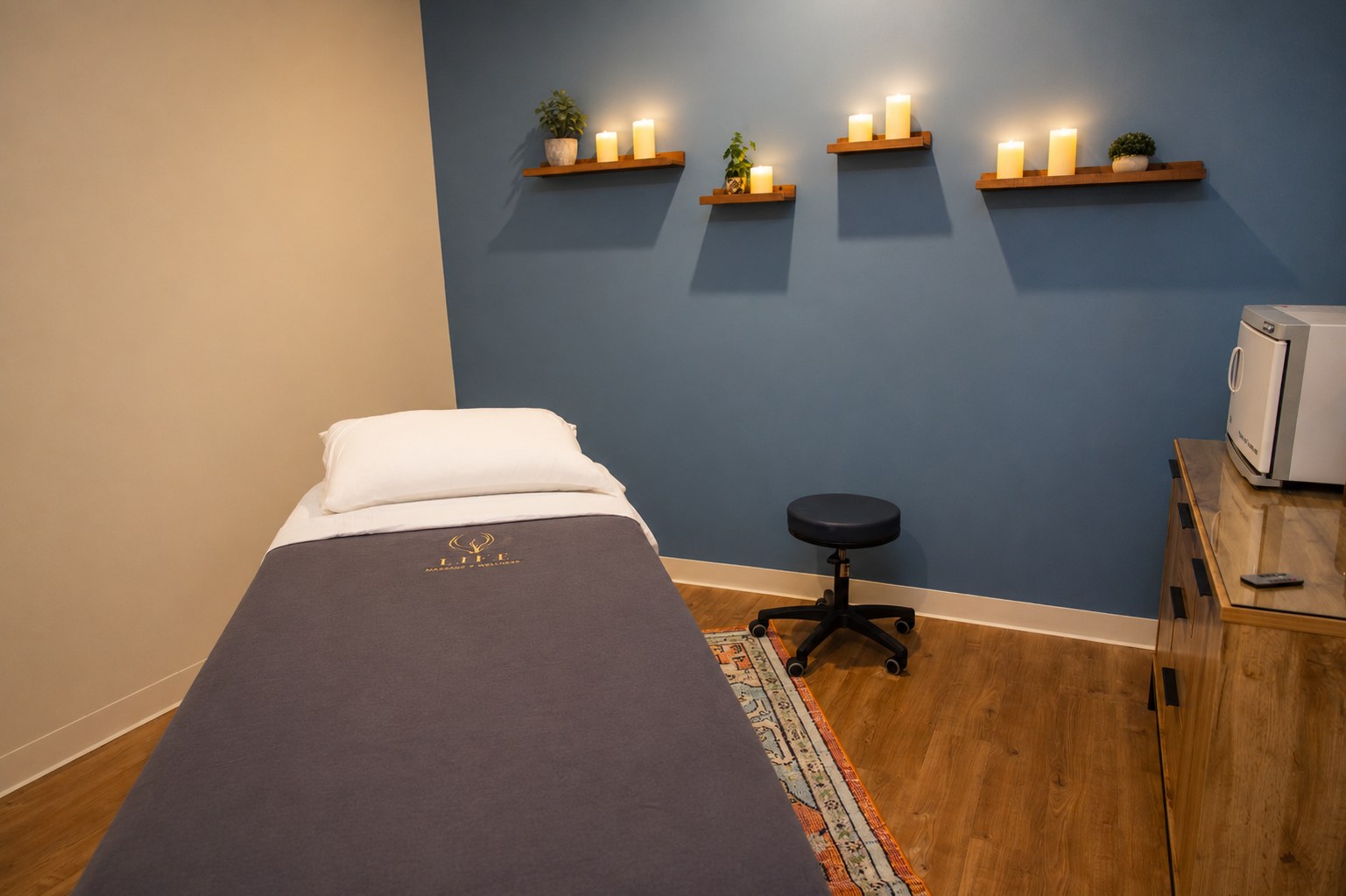
You undress to your comfort level and rest under a sheet on a warm table, fully draped with only the working area uncovered. Our oils are water soluble and made not to stain.
Sixty or ninety minutes of methodical work through the likely muscles. Your therapist holds each point while you rate the sensation, moving on once the number drops.
Expect mild soreness in the treated spots for a day or two. You will leave with two or three simple stretches that take a few minutes daily and make a real difference.
Realistic expectations help here. A point that formed last month may release in one session; one you have had for five years often takes two or three visits spaced a week or two apart before it stops reforming. Your therapist will tell you plainly which one they think you have rather than selling you a package up front. What tends to decide it is not the therapy at all but whether the conditions that built the point change, which is why the home stretches and a few small adjustments to how you sit or work matter as much as anything we do on the table.

Trigger point work is a skill of accuracy rather than strength, and it depends completely on a therapist who can find the right spot and has the patience to stay there. Our Portsmouth therapists are trained in the referral patterns, and they will explain what they are finding as they go rather than working in silence, which most clients find genuinely interesting.
Our studio at 95 Brewery Ln, Unit #17 sits minutes from downtown Portsmouth with free parking right at the door, which is a small mercy when you are arriving with a shoulder that has been at your ear all day. We are open seven days a week with evening hours, so a session fits around work instead of competing with it.
Portsmouth keeps a lot of people at screens, behind wheels, and on their feet in kitchens, shops, and workshops, which are precisely the conditions that manufacture trigger points. Our team sees these patterns constantly and recognizes them quickly. If what you actually need is broader work, we will say so and steer you toward neuromuscular therapy or a full classic session instead.
Clients come to us from across the city and from Rye, Greenland, Newington, Dover, Newmarket, and Kittery, quite a few of them after years of tennis balls against a doorframe. We are glad to take it from here.
Trigger points come back when the conditions that made them do not change. A membership includes one session each month from $105, member rates on every additional visit, and rollover hours for up to six months, month to month with no long commitment.
For the person who has been complaining about the same shoulder for as long as you have known them. Any amount, any service, either studio, purchased online in minutes.
Still have a question? We’re happy to talk it through before you book.
Deep tissue massage applies firm pressure with continuous movement across broad areas of chronic tension. Trigger point therapy is stationary and specific: your therapist finds one small point, holds steady pressure on it for thirty to ninety seconds until it releases, then moves to the next. A session might address four or five points thoroughly rather than covering the whole body.
There is a strong, distinctive sensation when a point is engaged, and most clients call it a good hurt rather than pain. We use a one to ten scale and aim for around a seven, where the work is unmistakably productive but you are still breathing comfortably. If you find yourself holding your breath or tensing elsewhere, that is too much and we adjust immediately.
It depends heavily on how long it has been there and whether the conditions that created it change. A recent point may release in a single session. One you have carried for years often needs two or three visits spaced a week or two apart, plus the home stretches, before it stops reforming. Your therapist will give you a straight assessment after the first visit.
Put the tennis ball down. Bring us the knot you have been fighting and let us find what is actually causing it.
Therapeutic massage and specialty wellness in Portsmouth, NH and Amesbury, MA.
Portsmouth: 603 373 8780
Amesbury: 978 792 5201
Sunday 8:00 am – 5:00 pm
Monday – Thursday 8:00 am – 7:00 pm
Friday 8:00 am – 6:00 pm
Saturday 8:00 am – 5:00 pm
Sunday Closed
Monday – Thursday 9:00 am – 8:00 pm
Friday 9:00 am – 6:00 pm
Saturday 9:00 am – 5:00 pm
Sunday 8:00 am – 5:00 pm
Monday – Thursday 8:00 am – 7:00 pm
Friday 8:00 am – 6:00 pm
Saturday 8:00 am – 5:00 pm
Sunday Closed
Monday – Thursday 9:00 am – 8:00 pm
Friday 9:00 am – 6:00 pm
Saturday 9:00 am – 5:00 pm